
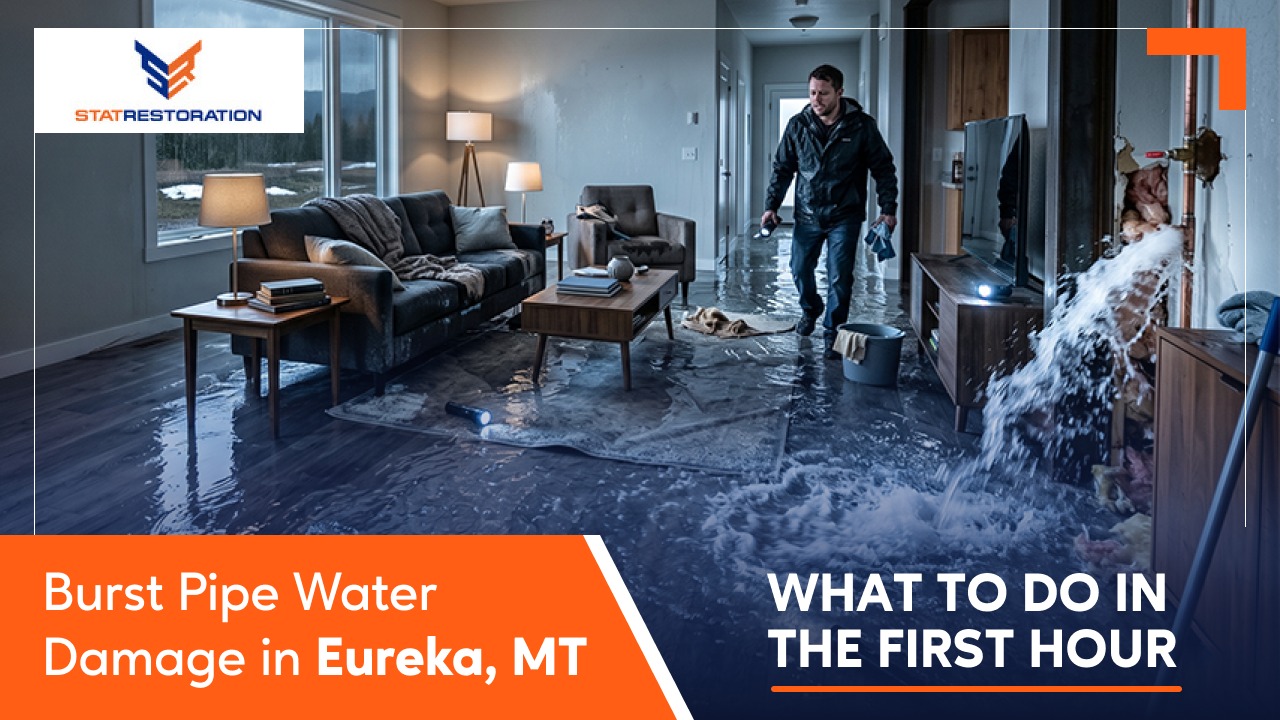
Burst Pipe Water Damage in Eureka, MT: What to Do in the First Hour
When temperatures in the Tobacco Valley drop below zero — and in Eureka, they routinely drop to -20°F or lower during January and February — frozen pipes are not an if, they’re a when. And when a pipe bursts in an Eureka home, the water release is sudden, high-volume, and indiscriminate. A half-inch copper supply line under 60 PSI can release 8–10 gallons per minute before it’s shut off. In the time it takes to locate the main shutoff, that’s hundreds of gallons in your walls, your ceiling, your flooring.
This guide walks through exactly what to do in the first hour, why calling an Eureka water mitigation company immediately is critical, and what professional water damage cleanup in Eureka involves after the water is stopped.
Why Eureka Homes Are Especially Vulnerable to Frozen Pipes
Eureka’s elevation (2,577 feet), its position in the Tobacco Valley, and its continental climate create winter conditions significantly harsher than much of western Montana. Key risk factors specific to Eureka:
Building stock age — Much of Eureka’s residential inventory was built between the 1950s and 1990s, before modern pipe insulation standards and building envelope requirements. Pipes in exterior walls and uninsulated crawl spaces are common.
Extended freeze periods — Eureka experiences multi-day stretches below 0°F, which gives pipe temperatures in uninsulated cavities time to drop well below freezing even in heated homes. A single cold night rarely freezes pipes; a 5-day cold snap at -15°F does.
Vacant and vacation properties — Lincoln County has a significant number of seasonal and vacation properties that may be inadequately winterized when owners are away. A thermostat failure or heating outage in January can mean frozen and burst pipes discovered weeks later.
Outdoor and crawl space plumbing — Hose bibs, outdoor spigots, and pipes in unheated crawl spaces are the most common freeze failure points in Eureka homes.
First 60 Minutes: Your Priority Checklist
Speed determines how much damage you’re dealing with. Every minute of uncontrolled water release adds to the total restoration scope and cost.
Minute 0–5: Shut off the water The main water shutoff for most Eureka homes is either at the meter near the street, in the mechanical room, or in the crawl space. Know where yours is before there’s an emergency. Shutting off the main cuts water to the burst pipe within seconds.
Minute 5–10: Turn off electricity to affected areas If water is near electrical panels, outlets, or fixtures, turn off the circuit breakers to affected areas at the panel. Do not enter standing water near any electrical source.
Minute 10–20: Document before cleanup Before moving anything or starting any extraction, photograph and video the water level, affected walls, flooring, and ceiling. This documentation is essential for insurance claims and should be done before conditions change.
Minute 20–30: Call a water mitigation company This is the single most important call you make. A certified water mitigation company brings truck-mounted extractors, moisture meters, and drying equipment that no combination of consumer tools can replicate. The faster professional extraction begins, the less structural drying — and potential mold remediation — you’ll need later.
Minute 30–60: Protect contents Move furniture, electronics, documents, and valuables off wet flooring if possible. Place aluminum foil under furniture legs to prevent staining from prolonged contact with wet carpet.
What a Burst Pipe Does to Your Home’s Structure

Water doesn’t stay where it lands. Understanding how water travels in a structure helps explain why professional moisture mapping is so critical.
In ceilings and walls: Water from a burst pipe in an upper floor or ceiling cavity soaks into drywall, runs along framing members, and exits at low points — often appearing at wall-ceiling junctions, door frames, or light fixtures on the floor below. The visible water is rarely at the actual failure point.
In floors: Water penetrates through subfloor joints, soaks into subfloor sheathing and finish flooring adhesives, and pools in the lowest accessible point — often a basement or crawl space. Even a “small” burst pipe on the second floor can fill a crawl space with several inches of water.
In wall cavities: Water that enters a wall cavity through a pipe failure soaks insulation, wicks into bottom plates, and begins traveling vertically through framing lumber. Insulation traps moisture against framing, dramatically slowing evaporation and accelerating mold growth conditions.
What Plumber vs. Water Mitigation Company — What Each Does
A critical point that many Eureka homeowners don’t know: a plumber and a water mitigation company do different things.
| Role | What They Handle |
| Plumber | Identifies and repairs the failed pipe; restores water supply |
| Water mitigation company | Extracts water, dries the structure, prevents mold, documents damage |
You need both — but you may not need them in that order. A water mitigation company can begin extraction and drying while you wait for a plumber to arrive for the repair, minimizing total drying time and damage.
StatRestore coordinates directly with plumbing contractors in the Eureka area and can manage the sequencing of trades to minimize your total restoration timeline.
Professional Water Damage Cleanup After a Burst Pipe in Eureka
Water Extraction Truck-mounted and portable extractors remove standing water from all affected areas. This is not a shop-vac operation — professional extractors process hundreds of gallons per hour and can access wall cavities, subfloor areas, and crawl spaces.
Moisture Mapping Thermal imaging cameras and calibrated moisture meters map the full extent of water migration — inside walls, under floors, above ceilings. Every affected material is logged and assigned a baseline moisture reading before drying begins.
Structural Drying Commercial air movers and low-grain refrigerant (LGR) dehumidifiers — not consumer fans — are positioned throughout the affected area in a calculated configuration. These industrial units achieve the specific airflow and grain depression needed to dry structural materials from the inside out. Daily moisture readings track progress toward goal moisture levels.
Material Removal (If Necessary) Saturated drywall, insulation, and finish flooring that cannot be dried in place are removed to expose framing. This step — though it looks like demolition — is restorative. Attempting to dry wet drywall in place traps moisture inside wall cavities and guarantees mold growth.
Mold Prevention Applied after structural drying is confirmed complete, EPA-registered antimicrobial treatments are applied to all previously wet surfaces before any rebuilding begins.
Frequently Asked Questions: Burst Pipe Water Damage in Eureka, MT
At what temperature do pipes freeze and burst in Eureka homes? Pipes in uninsulated exterior walls or crawl spaces can begin freezing when outdoor temperatures drop below 20°F, though the actual freeze depends on insulation, wind exposure, and heating. In Eureka’s harsh winters, outdoor spigots and crawl space plumbing are most vulnerable first.
How long does it take to dry a house after a burst pipe? Structural drying typically takes 3–5 days of continuous operation with professional equipment. Ceilings and walls that absorb significant water may take up to 7 days. Daily moisture readings determine when drying is complete.
Does homeowners insurance cover burst pipe water damage in Eureka? Yes — burst pipes resulting from freezing are a covered peril under standard homeowners policies, provided the home was maintained at adequate heat. Pipes that burst in a vacant home where heat was deliberately turned off may not be covered. StatRestore provides full insurance documentation.
Can I prevent pipes from freezing in my Eureka home? Yes: insulate pipes in crawl spaces and exterior wall cavities; maintain indoor temperature at minimum 55°F even when away; open cabinet doors under sinks on exterior walls during extreme cold; let one faucet drip on the coldest nights; know your main shutoff location.
How quickly does mold grow after a burst pipe? Mold colonization can begin in 24–48 hours on saturated materials. Professional extraction and drying that begins within 12–24 hours of the pipe burst is the most effective mold prevention measure.
StatRestore: Emergency Burst Pipe Cleanup in Eureka, MT
Available 24/7 — because pipes don’t burst on a schedule. StatRestore provides emergency water damage cleanup in Eureka, MT with rapid response to all Lincoln County communities.📞 [+14067528040] — 24/7 Emergency Line 🌐 All Water Damage Services →
