
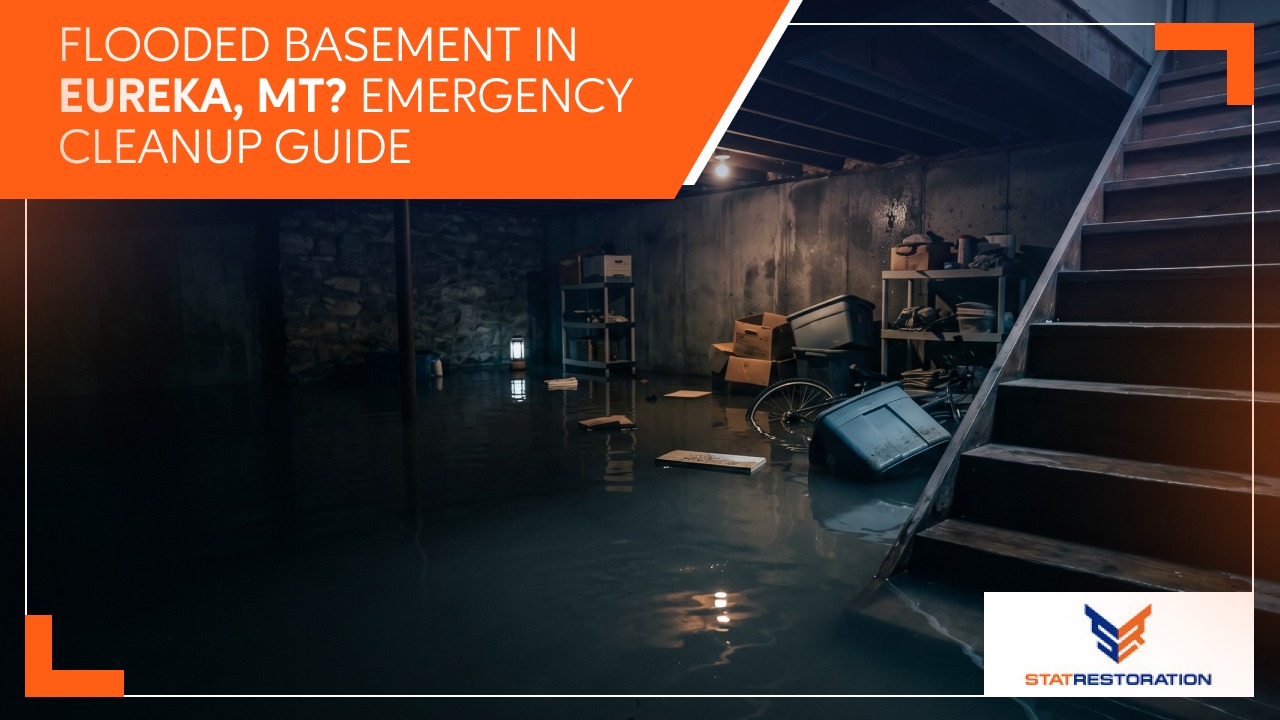
Flooded Basement in Eureka, MT: What to Do in the First 60 Minutes
A flooded basement in Eureka is a four-season event. In spring, Tobacco River drainage and snowmelt from the Purcell and Cabinet mountain ranges can saturate soil so thoroughly that water forces through foundation walls and floor joints regardless of how well a home’s drainage was designed. In winter, a frozen sump pump or a burst pipe fills a basement in hours. In summer, a severe storm can overwhelm drainage systems built for average rainfall, not extreme events.
Whatever brought water into your Eureka basement, the response protocol is the same — and the speed of that response determines how much of the damage is recoverable.
The Most Common Causes of Flooded Basements in Eureka, MT
Snowmelt-driven hydrostatic pressure — This is the most common spring basement flooding cause in Lincoln County. As snowpack melts from the surrounding mountains, soil becomes saturated for weeks. The hydrostatic pressure of water-saturated soil against foundation walls exceeds the capacity of older basement waterproofing — water seeps through block wall joints, floor/wall junctions, and cracks in poured concrete floors.
Sump pump failure — Many Eureka homes rely on sump pumps to manage groundwater. During extended storms or power outages, sump pumps fail — either from power loss, mechanical failure, or being overwhelmed by volume. A failed sump pump during a snowmelt event can fill an Eureka basement within hours.
Sewer backup — When Eureka’s municipal sewer system is overwhelmed during high-volume events, sewage can back up into basement floor drains and toilet connections. This is a Category 3 (black water) contaminated water event — the most serious classification, requiring specialized cleanup protocols.
Burst pipes — As discussed in detail in our burst pipe post, plumbing failures during Eureka’s hard winters can release large volumes of water into basement spaces rapidly.
Window well overflow — Below-grade window wells can fill and overflow during heavy rain, particularly when window seals are deteriorated. Less dramatic than sump failure but a frequent contributor to basement water events.
First 60 Minutes: Flooded Basement Checklist
Safety first — before entering a flooded basement:
- If there’s any possibility water is in contact with electrical outlets, the panel, or appliances — do not enter. Turn off power to the basement at the main breaker, or call an electrician before accessing.
- If the water source was a sewer backup (brown water, sewage odor), treat as contaminated water. Do not make skin contact without protective gloves and boots at minimum.
Stop the source if you safely can:
- For pipe failures: shut off the main water valve
- For sump pump failure: check power supply, check float switch position, restart if possible; if not, call a sump specialist
- For active storm flooding: there may be no way to stop the source until precipitation ends — focus on documentation and calling for help
Document before you move anything:
- Video and photos of water depth on walls, affected materials, contents position
- Note whether the water appears clean, gray, or brown (determines contamination category for insurance)
Call a water mitigation company immediately: This is the most important action in the first hour. Do not wait until the water stops or until you have insurance confirmation. Every hour of additional water contact increases material saturation, increases total restoration cost, and shortens the window before mold growth begins.
Move contents above water line: Electronics, documents, and irreplaceable items should be relocated to dry areas while you wait for the crew.
What Professional Flooded Basement Cleanup in Eureka Involves
Water Classification and Safety Protocol Before extraction begins, the water is classified:
- Category 1 (Clean water): From supply line failures, rainwater. Lowest health risk.
- Category 2 (Gray water): From appliance overflow, sump pump backup. Moderate contamination.
- Category 3 (Black water): Sewer backup, rising floodwater from outside. Highest contamination — requires biohazard protocols, specialized chemistry, and full PPE.
Classification determines cleanup approach and PPE requirements. StatRestore handles all three categories.
Extraction Commercial extractors remove standing water from all flooring, floor joints, and accessible cavities. Speed of extraction directly determines how much material can be dried in place vs. removed.
Moisture Mapping Concrete floors, block foundation walls, framing lumber, and any wall assemblies are assessed with moisture meters and thermal cameras. Block wall wicking — water absorbed into hollow concrete block walls — is particularly common in Eureka’s older housing stock and requires specific drying attention.
Structural Drying Commercial air movers and dehumidifiers run 24/7 until all materials reach target moisture levels. For a finished basement, drywall may need to be removed to allow wall cavity drying. For an unfinished basement, exposed concrete and framing typically dry within 3–5 days.
Mold Prevention Treatment Applied after confirmed drying, EPA-registered antimicrobial treatment on all affected surfaces.
Frequently Asked Questions: Flooded Basement in Eureka, MT
How much does flooded basement cleanup cost in Eureka? Costs range from $1,500–$8,000+ depending on square footage, contamination category, and whether any materials need to be removed. Free on-site estimates from StatRestore before work begins.
How quickly does mold grow in a flooded Eureka basement? In Eureka’s warm seasons (May–September), mold colonization on wet organic materials (drywall, wood framing) can begin in 24 hours. In cooler temperatures, the timeline is longer but not indefinitely — 48–72 hours is still the critical window.
Can I pump my flooded basement out myself? A sump pump or portable pump can remove standing water — but this addresses only the visible water. Concrete, block walls, and framing lumber absorb significant moisture that cannot be removed by pumping. Without professional structural drying, mold will grow in the absorbed moisture within days.
Is flooded basement cleanup covered by homeowners insurance in Eureka? Flooding from a covered internal source (pipe failure, appliance) is typically covered. Flooding from external water (rising groundwater, overland flow) requires separate flood insurance (NFIP). Sewer backup may be covered if you have a sewer backup endorsement. StatRestore assists with all insurance documentation.
StatRestore: Emergency Flooded Basement Cleanup in Eureka, MT
When your basement floods, every hour counts. StatRestore is available 24/7 for flooded basement cleanup throughout Eureka and Lincoln County.
📞 [+14067528040]— 24/7 Emergency Response 🌐 All Water Damage Services →
